Tap Settings → CAN Bus (any Display Mode).
VBOX Touch will display the CAN Settings screen.

The CAN Bus menu is where you can configure the settings for your CAN data capture. The menu is split into two sub-menus, one for each isolated CAN port on the VBOX Touch unit. The settings options are the same for both the top and bottom port.
The right half of each screen contains an image that indicates the location of the relevant port on the unit.
Use the navigation arrows in the bottom right corner, or swipe left and right on the screen, to navigate between the two Can Settings screens.
Return to the selected Display Mode screen, by tapping on the Exit button in the bottom left corner.
CAUTION
Connect to the vehicle CAN bus at your own risk. Incorrect connection may cause damage to the vehicle or the VBOX unit.
This setting lets you choose which CAN mode you want to use for this port.
You can choose between:
- RL Modules
- Input
- Output
- Disabled
Press on the ? to see an overview and an explanation of the different CAN modes.
When you have selected the CAN mode you want to use, you will get the option to configure the selected mode. Press the Configure button that appears below your CAN Mode selection.

This setting lets you choose which CAN mode you want to use for this port.
You can choose between:
- RL Modules
- Input
- Output
- Disabled
Press on the ? to see an overview and an explanation of the different CAN modes.
When you have selected the CAN mode you want to use, you will get the option to configure the selected mode. Press the Configure button that appears below your CAN Mode selection.

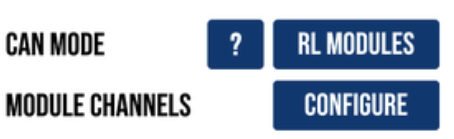
Tap the CAN Mode button to change it to RL Modules.
The Module Channels option will become available below.
Tap Configure to open the Select Racelogic Modules screen.
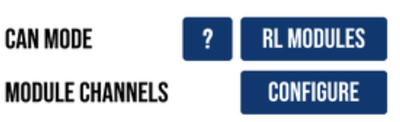
Tap the CAN Mode button to change it to RL Modules.
The Module Channels option will become available below.
Tap Configure to open the Select Racelogic Modules screen.
IMPORTANT
When logging module data, you must make sure that the Termination option on the relevant CAN Settings screen is Enabled.
Select the Racelogic module(s) you are connecting to from the list of available modules. You can select one or more.
Select a module by tapping the respective tick box on the left-hand side of the screen.
Tap the Confirm button when you have selected the required module(s) to confirm your selection.
Press the Cancel button if you want to return to the CAN Mode screen without changing the configuration.

NOTE
If you want to capture data from multiple modules of one type, for example two IMU modules, you must either separate the capture across the two ports or use Input mode.
If you are using more than two modules, you can use Input mode and set the modules up in a daisy chain. Refer to the Input section on the Configuration page for more information.
When you have confirmed the modules you want to use, the Input Modules screen will be displayed. This screen is split in two, with your selected modules on the left-hand side and the logged channels on the right-hand side.
Tap on a module on the left-hand side to see the channels it is logging.
Tap on a channel on the right-hand side to edit it.


This settings screen contains relevant information for the selected channel.
If you prefer to use other measurement units, you can configure the name, unit, scale, and offset for the channel separately from the global setting on your unit.
Tap on a setting value to change it.
If the module is connected and transmitting data, you can see the live channel value in the field at the bottom.
Tap on the Confirm button in the bottom right corner of the Edit Selected Channel screen to save the current channel information and return to the Input Modules screen.
Tap on the Cancel button in the bottom left corner to return to the Input Modules screen without changing the channel.
IMPORTANT
When you are using RL modules, you have to set them to Timed CAN mode with default output message identifiers. You must do this in VBOX Setup before you start logging.
You can use Input mode to capture single or multiple CAN modules or if you need to capture multiple RL modules of the same type (in a daisy chain).
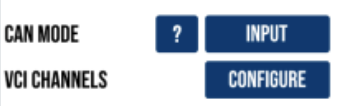
You can use Input mode to capture single or multiple CAN modules or if you need to capture multiple RL modules of the same type (in a daisy chain).
IMPORTANT
- There is a limit of 64 logged CAN channels, applied across both CAN ports.
- You must make sure that the Baud Rate and Termination settings match the expected connection on the relevant port.
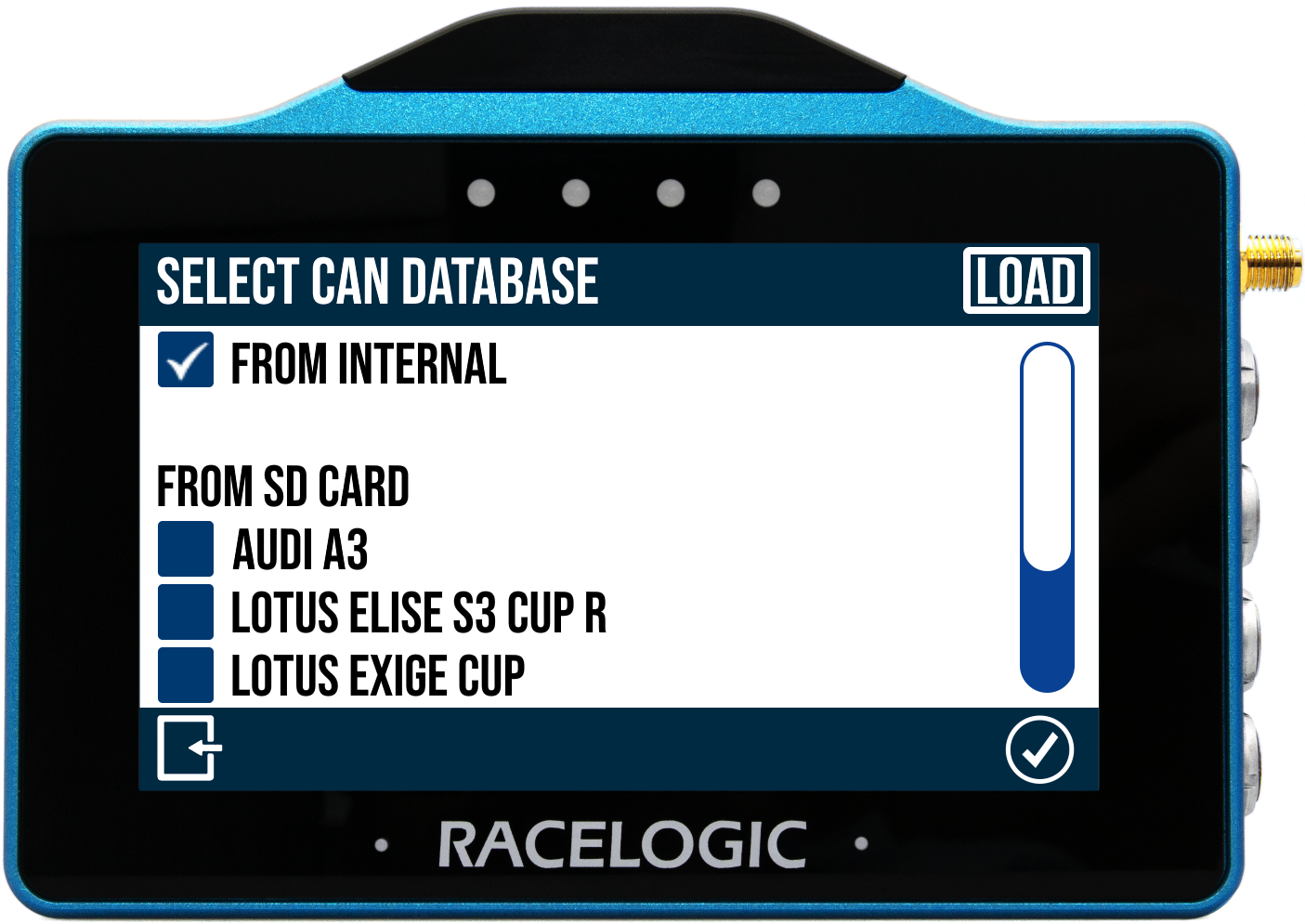
When you configure the port to capture CAN Input, you must first select which database you are using to decode the incoming data.
VBOX Touch will display a list of options. You can either select the internal vehicle CAN database or you can load external DBC files from an SD card.
Internal Vehicle Database
To use the internal vehicle database, select From internal by tapping the tick box. VBOX Touch will display comprehensive list of makes and models with available channels.
Select the required channels by tapping the respective tick boxes on the left-hand side of the screen.
Tap the Exit button if you want to return to the CAN Settings screen without saving.
Tap the Confirm button to confirm your selection and open the Select Channels to Log screen.
From SD Card
Save the required DBC file(s) in the CAN Databases folder on the root of the SD card before you insert it into VBOX Touch.
When VBOX Touch detects DBC files on the SD card, it will display a list of available CAN databases in the From SD card section of the screen.
Select the databases you want to use or configure by tapping the respective tick boxes on the left-hand side of the screen.
Tap the Confirm button to load the database and see available channels on the Select Channels to Log screen.
The name of the chosen database will be displayed at the top of the page with a list of available channels underneath.
Select a channel by tapping the respective tick box on the left-hand side of the screen.
Tap on a channel name to open the Edit Selected Channel screen and configure the channel.
This settings screen contains relevant information for the selected channel.
If you prefer to use other measurement units, you can configure the name, unit, scale, and offset for the channel separately from the global setting on your unit.
Tap on a setting value to change it.
If the module is connected and transmitting data, you can see the live channel value in the field at the bottom.
Tap on the Confirm button in the bottom right corner of the Edit Selected Channel screen to save the current channel information and return to the Input Modules screen.
Tap on the Cancel button in the bottom left corner to return to the Input Modules screen without changing the channel.
You can also load already configured channels from a channel configuration file on your SD Card.
Tap on the Load button in the top right corner of the Select Channels to Log screen. Select the file you want to load and tap Yes.
You can save your current configuration to a channel configuration file by tapping the Save button in the top right corner of the Select Channels to Log screen, entering a name for the file and tapping the Confirm button in the bottom right corner.
Both the top and the bottom CAN/Serial port have the ability to output GNSS and Lap Timing CAN data.
Both the top and the bottom CAN/Serial port have the ability to output GNSS and Lap Timing CAN data.
Enable or Disable CAN termination for the relevant CAN/Serial port.
Termination should be enabled when VBOX Touch is at the end of a CAN bus. If the unit is connected in an existing CAN network that is already terminated, termination should be disabled.

Enable or Disable CAN termination for the relevant CAN/Serial port.
Termination should be enabled when VBOX Touch is at the end of a CAN bus. If the unit is connected in an existing CAN network that is already terminated, termination should be disabled.

NOTE
When you are using the internal CAN database, termination will be set automatically.
The CAN Baud Rate defines the communication speed of the CAN bus.
Set the Baud Rate to match the existing CAN network or the connected device. If the baud rate does not match, VBOX Touch will not be able to communicate with the connected device.

The CAN Baud Rate defines the communication speed of the CAN bus.
Set the Baud Rate to match the existing CAN network or the connected device. If the baud rate does not match, VBOX Touch will not be able to communicate with the connected device.

NOTE
When you are using the internal CAN database, the baud rate will be set automatically.