
Please register your VBOX 4 unit so that Racelogic can continue to provide you with notifications about the latest software releases and firmware upgrades for your Racelogic product, and offer technical support.
Register your device here.
- Connect one end of an antenna cable to the connector on the antenna(s).
- Place the antenna(s) on the roof of the vehicle.
You can read more about how and where to place the GNSS antennas here. - Connect the primary (A) and secondary (B) antennas to the A and B antenna ports on the VBOX 4 unit.
- Connect the power cable to the PWR port on the VBOX 4 unit.
- Connect the Tablet/Laptop to the USB port on the VBOX 4 unit with the USB cable (RLCAB042).
- Secure the VBOX unit in the vehicle.
You can, for example, place it in the foam insert in the carry case and secure the carry case in the back seat of the vehicle with the seat belt.
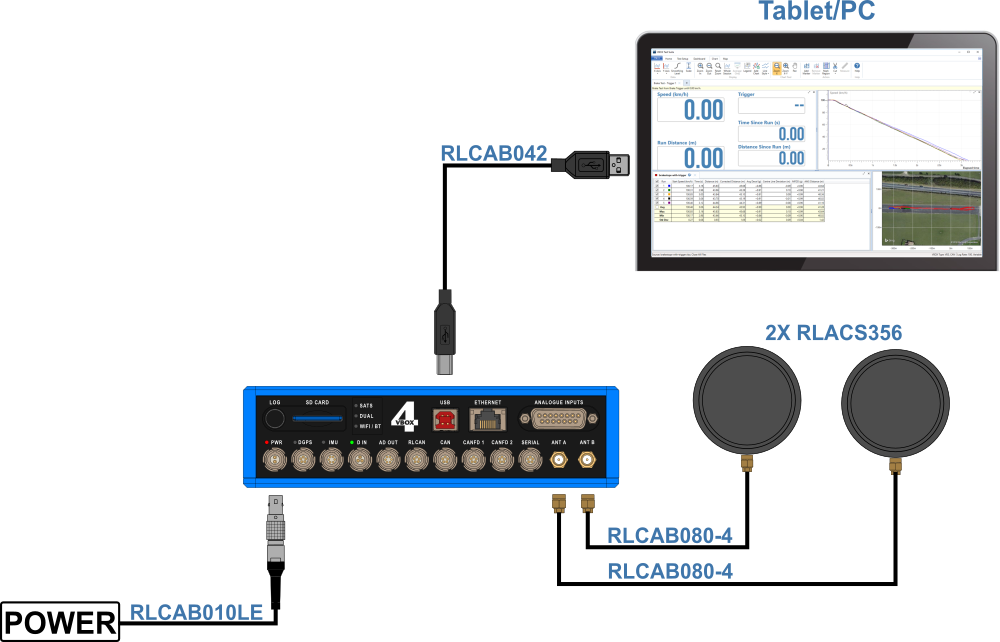
You can find the complete information about how to connect your VBOX 4 unit to the different modules and accessories required for testing here.
VBOX 4 units have a USB 2.0 connector that you can use to configure your VBOX unit and output real-time serial data at the full 100 Hz data rate.
Before you connect your VBOX unit to your computer, you must make sure that you have downloaded and installed the VBOX Setup software. This will install the required USB drivers on your computer.
The software installation will place the VBOX USB drivers in the following location on your computer. C:\Program Files\Racelogic\Drivers.
When you connect a powered VBOX 4 unit to your computer for the first time, your PC will recognise the presence of new hardware and open the typical Windows install window for new hardware. Follow the on-screen prompts and point the Windows installation to the location of your drivers.
VBOX 4 units have an internal Bluetooth antenna to give you the ability to connect to your VBOX unit and output real-time serial data at the full 100 Hz data rate via Bluetooth.
You can find information about how to connect via Bluetooth here.
To configure your VBOX unit via Bluetooth, you must make sure that you have downloaded and installed the VBOX Setup software.
To view live data, you must make sure that you have downloaded and installed the VBOX Test Suite software.
VBOX Setup is a software application that configures VBOX 4 units. You can download the VBOX Setup software here.

The connection between the VBOX unit and the computer should be made via USB or Bluetooth for optimum performance.
When the VBOX unit is physically connected and powered, open the VBOX Setup software and use the dropdown list to select the COM port that your VBOX unit is connected to. Click Connect. VBOX Setup will open the configuration window for your VBOX unit.
Note: You may see an auto-detect message if you have changed the baud rate from the default value. Click Yes to allow the different baud rates to be scanned.

Available menus
The menu tiles in the sidebar allows you to select between the different menus. Click button to open that menu.

Available menus
The menu tiles in the sidebar allows you to select between the different menus. Click button to open that menu.

Menu title
Displays the title of the menu you are currently in.

Menu title
Displays the title of the menu you are currently in.

Help
Depending on which menu you have open, the question mark icon will open up the corresponding User Guide page in the Racelogic Support Centre, to provide more information about the features and settings in this menu.

Help
Depending on which menu you have open, the question mark icon will open up the corresponding User Guide page in the Racelogic Support Centre, to provide more information about the features and settings in this menu.

Language
Change the operating language.

Language
Change the operating language.
Settings Area
The main area in the application window (white background) contains the options for the menu you have selected.

Load
Click on the Load icon to load an existing configuration file into VBOX Setup.

Load
Click on the Load icon to load an existing configuration file into VBOX Setup.

Save
Click on the Save icon to save your current configuration to a VBOX configuration file on your local computer.

Save
Click on the Save icon to save your current configuration to a VBOX configuration file on your local computer.

Reset Defaults
Click on the Reset defaults button to reset the current configuration to the VBOX Setup default settings.

Reset Defaults
Click on the Reset defaults button to reset the current configuration to the VBOX Setup default settings.

Write to unit
After making changes to the configuration, you must press the Write to unit button to make sure that the settings are uploaded to the connected VBOX unit.

Write to unit
After making changes to the configuration, you must press the Write to unit button to make sure that the settings are uploaded to the connected VBOX unit.

Close
Closes the software, if changes have not been saved to the unit, you will be prompted to save the settings.

Close
Closes the software, if changes have not been saved to the unit, you will be prompted to save the settings.
Click on a menu below to see more information about it.
General
Save and load configuration files, see general information about your VBOX 4 unit including serial number and firmware version.
Channel Setup
Configure the channels for logging the required data with your VBOX 4 unit.
Logging
Configure your logging conditions for your VBOX 4 unit.
GNSS
Configure the GNSS settings for your VBOX 4 unit.
Slip Angle
Include additional slip measurements from other locations when using VBOX 4 ADAS or VBOX 4 Dynamics models.
IMU
Configure your IMU integration.
ADAS
Configure your VBOX 4 ADAS for ADAS testing.
CAN
Configure the CAN settings, export .dbc files, and enable full bus logging for the CANFD ports.
Ethernet
Configure the Ethernet settings for your VBOX 4 unit.
MFD
Configure which channels you want to be able to view on an MFD Touch unit connected to your VBOX 4.
Configure advanced settings such as digital and analogue outputs, and local coordinates.